

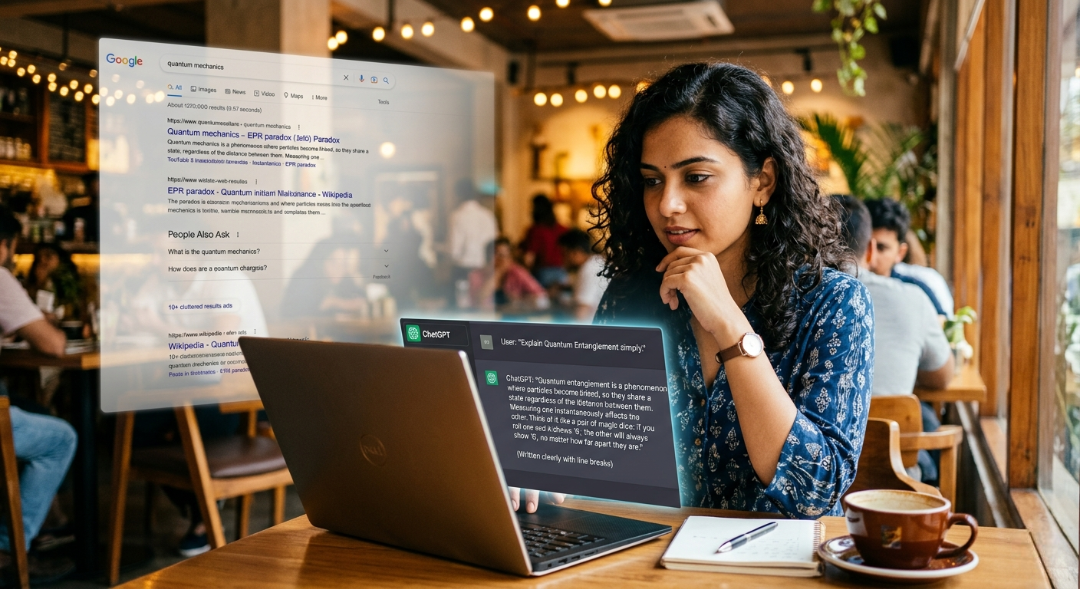
It starts small. You type a question into Google with ChatGPT, scan the blue links, click a couple, and still feel like you’re piecing together the answer yourself. Then one day, you try ChatGPT instead. You ask the same thing in plain English, and it hands you a clear, complete response — no tabs, no ads, no hassle.
Suddenly, that little experiment becomes a habit. You’re not alone. Across kitchens, offices, and late-night study sessions, people are quietly shifting how they find information online. It’s not a loud rebellion with headlines screaming “Google is dead.” It’s a subtle change in daily routines. But make no mistake — this shift is real, and it’s reshaping the way we search in 2026.
Have you noticed yourself reaching for ChatGPT more often lately? Or wondered why a simple query now feels easier in an AI chat than on the world’s biggest search engine? Let’s unpack what’s actually happening, why it matters right now, and where things might head next.
The Quiet Shift: From Blue Links to Conversational Answers
Traditional Google search works like a helpful librarian pointing to books on a shelf. You get a list of results, and it’s up to you to dig through them. ChatGPT, on the other hand, feels more like chatting with a smart friend who has read all those books and summarizes the best parts for you.
This difference is at the heart of the change. Instead of keywords and ten blue links, users now expect natural conversation. Ask “What’s the best budget phone for photography under 30,000 rupees?” on Google, and you’ll sift through reviews. Ask the same in ChatGPT, and you often get a tailored comparison, pros and cons, and even follow-up suggestions in one go.
Did you know that by early 2026, ChatGPT was handling billions of prompts daily, with many users treating it as their go-to for everything from quick facts to deep research? Studies show a noticeable portion of people — especially younger users and professionals — now start complex queries with AI tools first.
It’s not that Google has disappeared. Far from it. Google still dominates overall search volume with billions of daily queries. But for certain tasks, the old way just feels outdated.
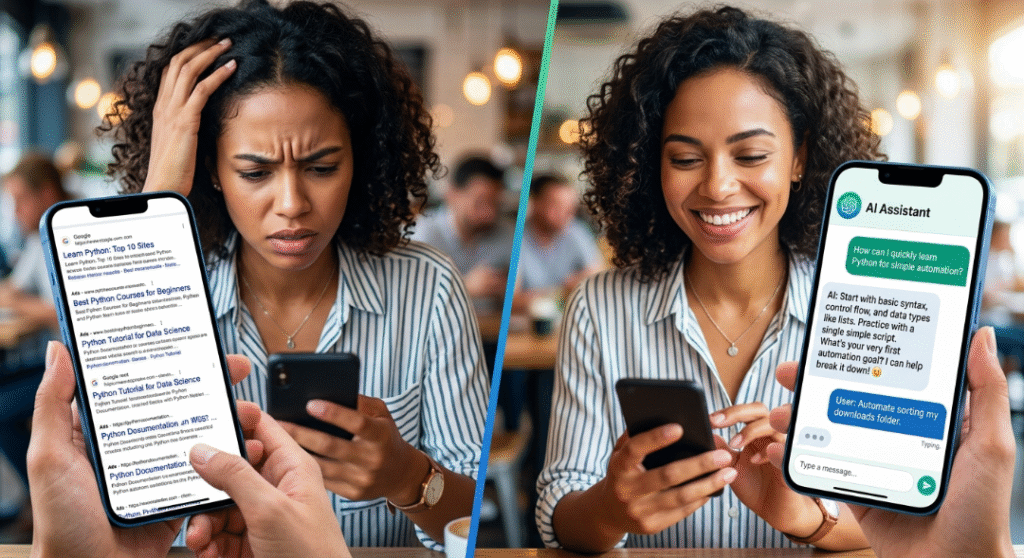
Why People Are Making the Switch Right Now
The reasons aren’t mysterious. They’re practical and emotional.
First, speed and simplicity. Life moves fast. No one wants to wade through sponsored ads or outdated pages. ChatGPT delivers synthesized answers instantly, often with sources cited. It’s conversational — you can say “Explain it like I’m 15” or “Compare it with last year’s model,” and it adjusts without you rephrasing everything.
Second, frustration with traditional search. Google has introduced AI Overviews (those summary boxes at the top), but many users still complain about too many ads, SEO-optimized fluff, and the need to click multiple links. One user shared how they ditched Google for a week and felt more productive with ChatGPT handling planning, research, and even recipe tweaks in real time.
Third, personalization and context. AI remembers conversation history (in many cases) and builds on previous questions. Planning a trip? You can ask about flights, then hotels, then “What if I have a layover in Dubai — any tips?” without starting over.
Here’s a relatable scenario: A student preparing for exams used to bookmark dozens of pages. Now, they chat with ChatGPT, get structured notes, and even ask it to quiz them. A working parent compares baby products without opening ten review sites. Efficiency wins.
Surprisingly, data shows this isn’t always a full replacement. Many people use both tools depending on the task — Google for quick lookups or local info, ChatGPT for deeper or multi-step reasoning. It’s expanding how we search rather than killing one habit entirely.
Real-World Examples of the Change
Think about daily life in India and globally.
- Shopping decisions: Someone searching “best smartphone under 20,000 with good camera” on Google sees lists. On ChatGPT, they get a personalized recommendation based on needs like battery life for travel or gaming performance, complete with current prices pulled from recent data.
- Learning and work: Professionals use AI for summarizing reports, brainstorming ideas, or debugging code. One developer mentioned cutting research time in half by asking ChatGPT instead of hunting Stack Overflow threads.
- Health and lifestyle: Curious about “home remedies for acidity” or “beginner yoga routine for back pain”? AI gives step-by-step guidance with caveats to consult a doctor — more engaging than dry web pages.
Even news consumption is shifting. Instead of scanning headlines, users ask for balanced summaries: “What’s the latest on the budget announcement and how does it affect middle-class families?”
These aren’t edge cases. Surveys from 2025-2026 show growing adoption, especially for informational and decision-making queries where conversation shines.
The Surprising Pros and Cons
Let’s be honest — no tool is perfect.
Pros of leaning on ChatGPT-like tools:
- Faster answers without the noise.
- Better handling of complex, follow-up questions.
- More natural, human-like explanations.
- Often higher engagement — longer session times because it feels interactive.
Cons and realities:
- Hallucinations or outdated info if not connected to real-time search (though 2025-2026 updates improved this significantly).
- Less transparency sometimes — you might not see the full range of sources as easily as Google’s links.
- Privacy concerns: Conversations can feel more personal.
- Not ideal for everything, like highly localized searches or breaking news where Google’s index still excels.
Google isn’t sitting idle. Its own Gemini integration and AI Overviews are responses to this pressure, blending traditional results with generative summaries. The competition is pushing everyone to improve.
The surprising part? Many users report using more tools overall, not less. ChatGPT sparks curiosity that leads back to deeper Google dives or specific sites. It’s not zero-sum.
How This Affects Everyday Users and the Web
This shift matters because information discovery is changing. For creators and website owners, fewer clicks from traditional search means rethinking visibility. Content needs to be clear, authoritative, and structured so AI can understand and cite it properly.
For regular users like you and me, it means better tools — but also the responsibility to verify important info. AI is helpful, but critical thinking remains key, especially for health, finance, or news.
Emotionally, it feels liberating. No more “10 tabs open” overwhelm. Yet there’s a tiny nostalgia for the old web exploration feel.
Rhetorical question: When was the last time a Google search truly surprised or delighted you with its depth, versus just listing options?
Future Outlook: What to Expect in the Next 3–6 Months
Looking ahead to late 2026 and beyond, the lines will blur further.
Expect more integrated AI search features across platforms. ChatGPT continues adding real-time web access, visuals, and even agent-like capabilities for tasks. Google will likely deepen its AI Mode, making summaries smarter and more actionable.
Analysts predict traditional search volume could drop noticeably as AI handles more queries directly. Yet total information-seeking might grow because it’s easier.
By the end of 2026, we could see:
- Better memory and personalization in AI chats.
- More multimodal experiences — voice, images, and video baked in.
- Hybrid tools where AI and traditional search coexist seamlessly.
The big question isn’t whether one replaces the other, but how we’ll navigate a world with multiple intelligent assistants. Competition from Gemini, Grok, Claude, and others will keep innovation high.
Actionable Tips: How to Make the Most of This Shift
Don’t abandon Google completely. Instead, experiment smartly:
- Use ChatGPT for open-ended or comparative questions.
- Stick with Google for precise facts, maps, or shopping prices.
- Always cross-check important information — especially from multiple sources.
- Try prompting techniques: Be specific, ask for sources, or request step-by-step reasoning.
- Explore settings for privacy and memory features in your favorite AI tool.
Small habit changes can save hours weekly. Try replacing one daily search type this week and notice the difference.
Why This Feels Like More Than a Trend
At its core, this quiet replacement isn’t about hating Google. It’s about craving tools that respect our time and speak our language. The web has grown messy with ads and optimization games. AI offers a cleaner, more intuitive path — at least for now.
But the web’s strength has always been diversity of voices. As we shift, supporting quality creators remains important so answers stay rich and accurate.
What do you think — has ChatGPT changed how you search, or are you still team Google? The conversation is just beginning.
FAQs
Is ChatGPT actually replacing Google search in 2026? Not fully. Google still handles the vast majority of searches, but ChatGPT and other AI tools are taking a growing share for conversational and complex queries. Many users combine both.
Why do people prefer ChatGPT over Google for some tasks? It provides direct, synthesized answers in natural language, saves time by reducing clicks, and handles follow-ups conversationally. It’s often less cluttered with ads.
Will traditional search engines disappear because of AI? Unlikely in the next few years. Predictions suggest a 25% drop in traditional search volume by end of 2026, but Google and others are evolving with their own AI features. Hybrid use seems to be the future.
Are answers from ChatGPT reliable compared to Google? They can be very good with real-time search enabled, but always verify critical info. AI can occasionally hallucinate or miss nuances that multiple web sources reveal.
How can I optimize my own searches in this new era? Be descriptive in prompts, ask for explanations or comparisons, and use both tools based on the task. For websites, focus on clear, authoritative content that answers real user questions deeply.
(Word count: approximately 1,720)

