

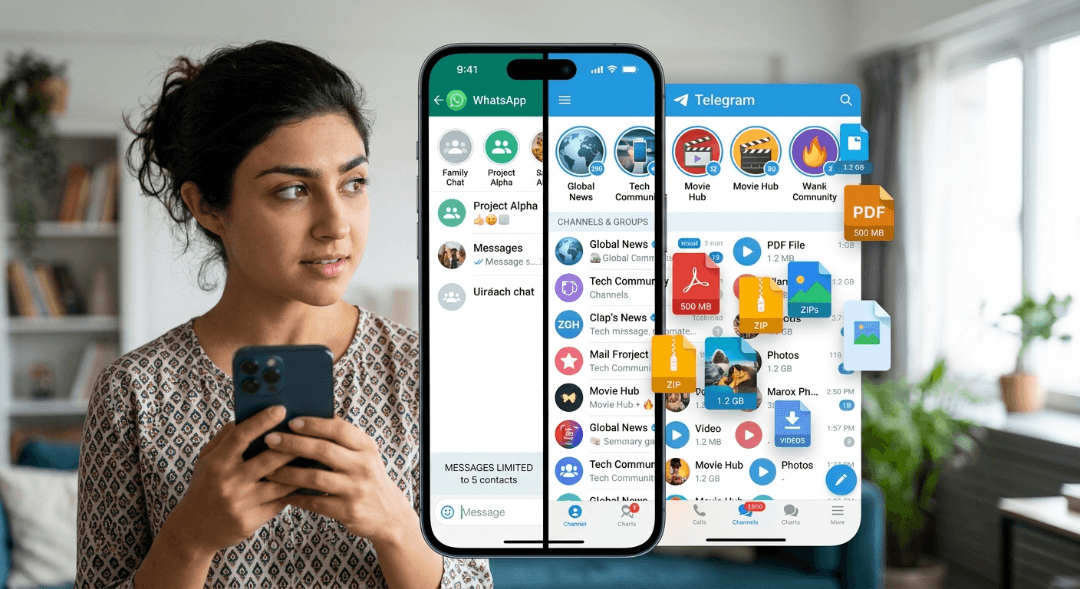
Have you ever opened WhatsApp and felt frustrated by yet another limit? A group that won’t let in more friends. A video that refuses to send because it’s “too big.” Or that nagging feeling your chats aren’t as private as you’d like?
You’re not alone. Across India and the world, millions are quietly downloading Telegram and making the switch. Not because WhatsApp is suddenly broken—but because Telegram offers something more exciting, flexible, and powerful in 2026.
The question on everyone’s mind isn’t “Which app is better?” anymore. It’s “Why does Telegram feel like the future while WhatsApp feels stuck?”
Let’s dive into what’s really happening. Telegram vs WhatsApp
What’s Driving the Shift Right Now?
Messaging apps used to be simple. Send a text, share a photo, done. But in 2026, we live in groups, communities, and broadcast lists. We share large files for work, study, or fun. We want spaces where hundreds—or even thousands—can connect without chaos.
WhatsApp still dominates with over 3 billion monthly active users. It’s the default for families, businesses, and quick chats in India. But growth has slowed, and users are noticing cracks.
Telegram, with around 1 billion monthly active users, is growing fast. It’s not replacing WhatsApp entirely—yet. Instead, many people now use both. WhatsApp for close family and friends. Telegram for everything else: bigger communities, content consumption, and advanced features.
Here’s the surprising part: This isn’t a sudden 2021-style privacy backlash. It’s a steady, feature-driven migration happening right now. Telegram vs WhatsApp
Did you know? Telegram added nearly 50 million new monthly active users in a short span recently, pushing past the 1 billion mark. People aren’t fleeing WhatsApp in panic—they’re adding Telegram because it solves real daily frustrations.

The Feature Gap That’s Hard to Ignore
Imagine planning a big family reunion or a college project group. WhatsApp caps groups at around 1,024 members. Telegram? Up to 200,000. That’s not just bigger—it’s a completely different scale.
File sharing tells a similar story. WhatsApp handles decent sizes now, but Telegram lets you send files up to 2GB (or 4GB with Premium) without compression headaches. Students sharing notes, professionals sending reports, or creators uploading high-quality videos—Telegram just works better.
Cloud storage is another game-changer. Your Telegram chats sync across all devices seamlessly, with unlimited history in most cases. No more worrying about losing old messages when you switch phones.
Multi-device support feels liberating too. Log in on your phone, tablet, laptop, and desktop without constant linking or battery drain issues that sometimes plague WhatsApp.
Here’s a quick side-by-side:
- Groups: WhatsApp ~1,024 | Telegram up to 200,000
- File Size: WhatsApp ~2GB | Telegram 2-4GB
- Channels: WhatsApp has them, but Telegram’s are more powerful for broadcasting to unlimited subscribers with persistent history.
- Bots: Telegram’s bot ecosystem is unmatched for automation, polls, games, and even mini-apps.
These aren’t fancy extras. They’re tools that change how you use messaging every single day.
Privacy and Security: The Nuanced Truth
Privacy conversations around these apps often get heated. WhatsApp offers end-to-end encryption by default for personal chats and calls. That’s a strong point—Meta can’t read your messages. Telegram vs WhatsApp
Telegram takes a different approach. Regular chats use cloud encryption, which allows seamless syncing but means messages aren’t end-to-end encrypted by default. For truly private talks, you use “Secret Chats” with self-destruct timers and extra controls.
Many users love Telegram’s granular privacy settings: hide your phone number, use usernames, control who sees your last seen status, or even restrict forwarding. It feels like you have more control over your digital life.
Is Telegram “less secure”? It depends on what you need. For everyday family chats, WhatsApp’s default encryption wins for many. For communities, content creators, or people who value anonymity and flexibility, Telegram’s tools shine.
The real story in 2026 isn’t one app being perfectly private. It’s about choosing the right tool for the right conversation.
Real Stories from People Who Switched
Rohan, a college student in Mumbai, got tired of creating multiple small WhatsApp groups for his class projects. “One Telegram group handles everything—notes, doubts, even bots for quick quizzes. No more switching between 10 chats.”
Priya runs a small business selling handmade jewelry in Bangalore. She started a Telegram channel for updates and offers. “My customers love the clean broadcast feel. I can send high-quality photos without size issues, and bots handle order queries automatically. WhatsApp Business is great, but Telegram scales better as I grow.”
Then there are content creators and communities. From tech news channels to fitness groups or local buy-sell circles—Telegram’s channels feel like a mix of messaging and social media without the algorithm drama of big platforms.
These aren’t rare cases. In India, where both apps are hugely popular, Telegram has carved a strong niche for larger, interest-based communities. Telegram vs WhatsApp
Why It Matters in 2026
We’re not just chatting anymore. We’re building communities, running businesses, sharing knowledge, and organizing events—all inside messaging apps.
WhatsApp excels at personal, one-to-one or small-group conversations. It’s simple, reliable, and everyone you know is probably there.
Telegram feels like a super-app in the making. Channels for content, bots for automation, mini-apps for games and services, and powerful search across your entire history.
The shift matters because our needs have evolved. A single app that does basic messaging isn’t enough when you want to:
- Follow daily news or updates without cluttering personal chats
- Collaborate with large teams or classes
- Share uncompressed media or documents
- Customize your experience with themes, folders, and advanced settings
Telegram delivers on these without feeling bloated.
Pros and Cons: A Balanced Look
Telegram Strengths:
- Massive scalability for groups and channels
- Superior file sharing and cloud storage
- Rich customization and bots
- Better multi-device experience
- Strong privacy controls and anonymity options
Telegram Weaknesses:
- End-to-end encryption not default (requires Secret Chats)
- Slightly steeper learning curve for new users
- Some features (like Premium) are paid Telegram vs WhatsApp
WhatsApp Strengths:
- Default end-to-end encryption
- Simpler interface loved by millions
- Deep integration with phone contacts
- Strong business tools in many regions
WhatsApp Weaknesses:
- Limits on group size and file sharing
- Less flexible for broadcasting or large communities
- Tied more closely to Meta’s ecosystem
The choice isn’t binary. Many smart users keep both and use each where it shines.
What the Next 3–6 Months Might Bring
Expect Telegram to keep pushing boundaries with more AI-powered bots, improved video features, and monetization options for creators. Channels could become even more interactive.
WhatsApp isn’t standing still. Rumors of usernames (reducing phone number sharing) and further business enhancements are in the air. It will likely focus on making its core experience smoother while expanding payments and commerce in markets like India.
The bigger trend? Hybrid usage. People won’t abandon WhatsApp overnight—network effects are too strong. But Telegram could become the go-to for communities, content, and productivity. Telegram vs WhatsApp
Regulatory changes, like SIM-binding rules in some regions, might affect both apps similarly, pushing users toward platforms that feel more user-friendly and feature-rich.
Actionable Tips If You’re Thinking of Switching
- Start small: Create a Telegram account and import your contacts. Join a few public channels in your interests to explore.
- Use both apps strategically: Keep personal family chats on WhatsApp. Move project groups, hobby communities, or broadcast lists to Telegram.
- Enable Secret Chats for sensitive conversations on Telegram.
- Explore folders and archived chats to keep your Telegram organized—it’s a lifesaver with heavy use.
- Try Telegram Premium for a month if you share lots of media. The faster downloads and extra features often feel worth it.
- Introduce friends gradually. Share a cool channel or bot instead of forcing a full switch.
The key? Don’t treat it as an all-or-nothing decision. Experiment and see what fits your life.
The Bigger Picture: Choice in Messaging
At the end of the day, having options is healthy. Competition pushes both WhatsApp and Telegram to improve. Users win when apps respect our time, privacy, and growing needs.
Telegram isn’t “killing” WhatsApp. But it’s proving that millions crave more than basic messaging. They want power, flexibility, and a sense of control in their digital conversations. Telegram vs WhatsApp
Whether you’re a student juggling classes, a professional managing teams, a creator building an audience, or just someone who hates file size limits—Telegram offers tools that feel refreshing in 2026.
The switch isn’t about abandoning old friends. It’s about adding a more capable companion to your phone.
So, tell me honestly—have you already started using Telegram more? Or are you still on the fence, wondering if it’s worth the effort?
The next time you hit a WhatsApp limit or crave a better way to connect with a bigger circle, you might just find yourself opening Telegram instead.
And that quiet shift? It could be the start of something bigger. Telegram vs WhatsApp
(Word count: approximately 1,720)
FAQs
Is Telegram really more private than WhatsApp? Not exactly by default. WhatsApp uses end-to-end encryption for all personal chats. Telegram offers strong cloud security and excellent user controls, but true end-to-end encryption requires enabling Secret Chats. Choose based on your specific needs.
Can I use both WhatsApp and Telegram together? Absolutely. Most people do. WhatsApp for close personal circles and quick calls. Telegram for larger groups, channels, file sharing, and communities. They complement each other well.
Will all my WhatsApp contacts move to Telegram? Not immediately. Network effect is strong. But as more people discover Telegram’s advantages, organic switching happens—especially in groups, classes, or interest communities.
Does Telegram cost money? Basic use is completely free. Telegram Premium unlocks faster speeds, larger uploads, and exclusive features for a monthly fee. Many users find the free version sufficient.
Is Telegram safe for business or important groups? Yes, for most uses. Its scalability and bots make it excellent for communities and customer engagement. For highly sensitive data, combine with Secret Chats or evaluate your specific privacy requirements carefully.

